Jolyna is studying nursing at Midena University.
Last year, she studied basic topics such as bacteria and the muscles of
the body.
Now in her second year, she is moving on to more specialized subjects.
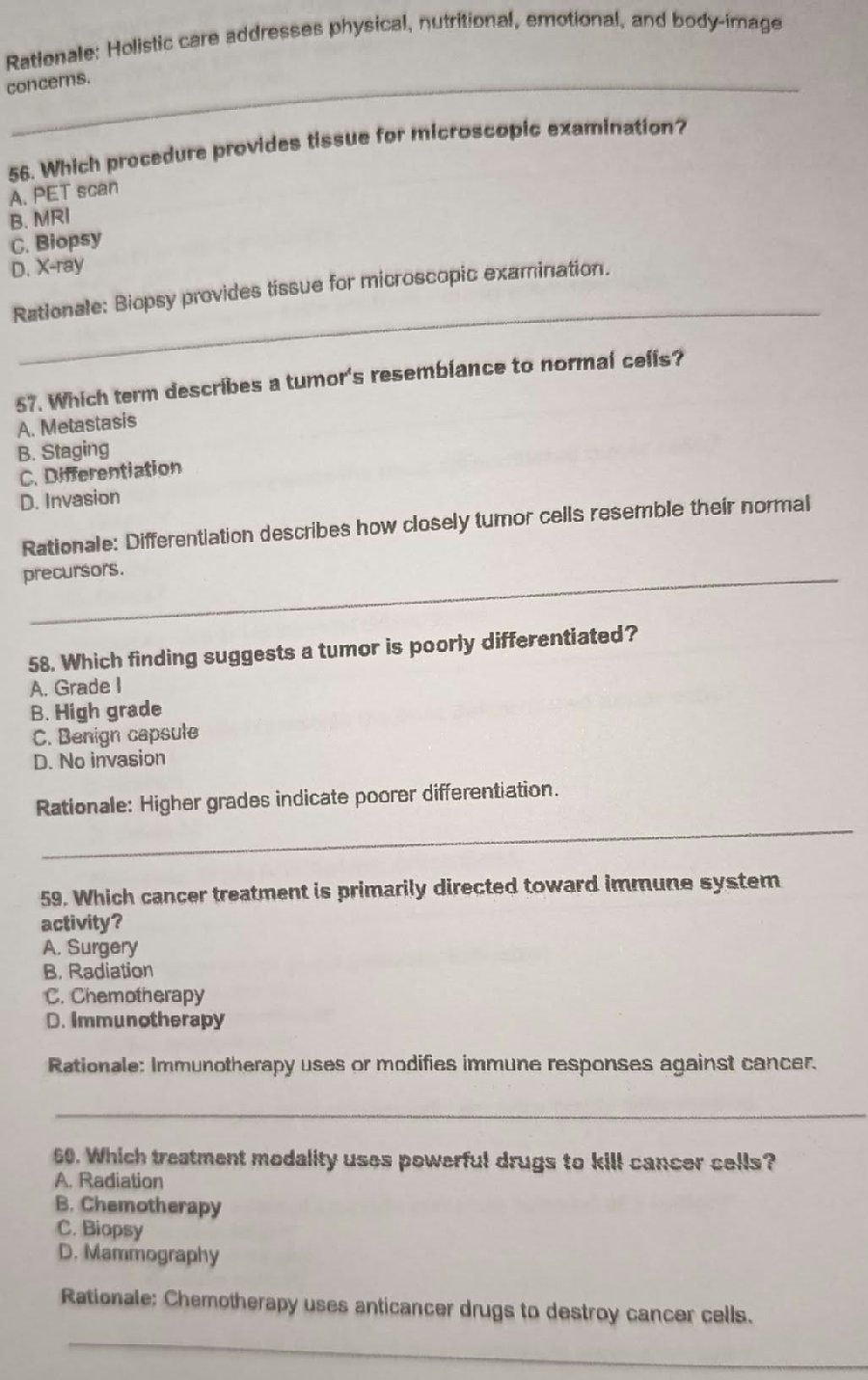
56. Which procedure provides tissue for microscopic examination?
A. PET scan
B. MRI C. Biopsy
D. X-ray Rationale: Biopsy provides tissue for microscopic examination.
57. Which term describes a tumor's resemblance to normal cells?
A. Metastasis
B. Staging C. Differentiation
D. Invasion Rationale: Differentiation describes how closely tumor cells resemble their normal precursors.
58. Which finding suggests a tumor is poorly differentiated?
A. Grade I B. High grade
C. Benign capsule
D. No invasion Rationale: Higher grades indicate poorer differentiation.
59. Which cancer treatment is primarily directed toward immune system activity?
A. Surgery
B. Radiation
C. Chemotherapy D. Immunotherapy Rationale: Immunotherapy uses or modifies immune responses against cancer.
60. Which treatment modality uses powerful drugs to kill cancer cells?
A. Radiation B. Chemotherapy
C. Biopsy
D. Mammography Rationale: Chemotherapy uses anticancer drugs to destroy cancer cells.
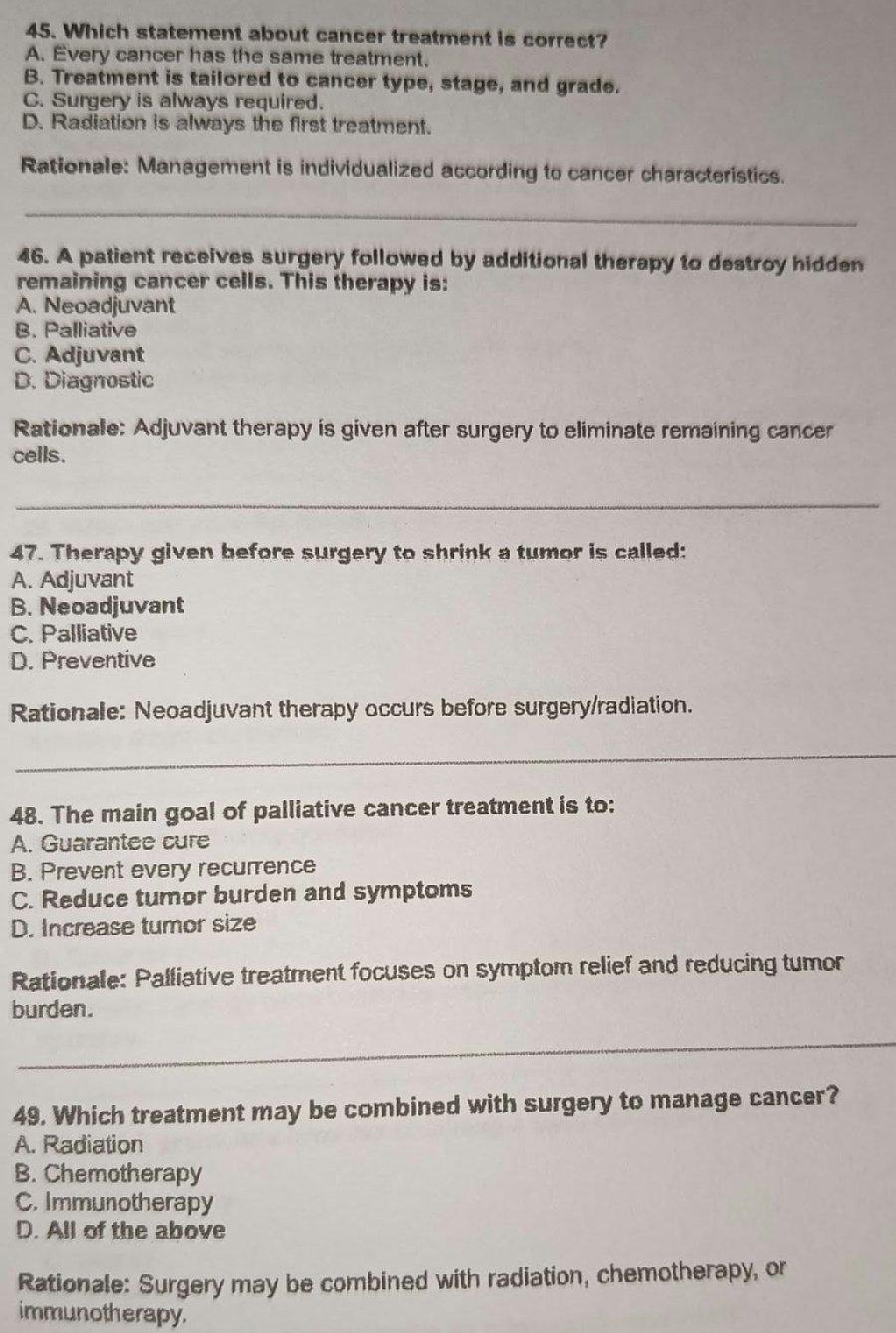
45. Which statement about cancer treatment is correct?
A. Every cancer has the same treatment. B. Treatment is tailored to cancer type, stage, and grade.
C. Surgery is always required.
D. Radiation is always the first treatment. Rationale: Management is individualized according to cancer characteristics.
46. A patient receives surgery followed by additional therapy to destroy hidden remaining cancer cells. This therapy is:
A. Neoadjuvant
B. Palliative C. Adjuvant
D. Diagnostic Rationale: Adjuvant therapy is given after surgery to eliminate remaining cancer cells.
47. Therapy given before surgery to shrink a tumor is called:
A. Adjuvant B. Neoadjuvant
C. Palliative
D. Preventive Rationale: Neoadjuvant therapy occurs before surgery/radiation.
48. The main goal of palliative cancer treatment is to:
A. Guarantee cure
B. Prevent every recurrence C. Reduce tumor burden and symptoms
D. Increase tumor size Rationale: Palliative treatment focuses on symptom relief and reducing tumor burden.
49. Which treatment may be combined with surgery to manage cancer?
A. Radiation
B. Chemotherapy
C. Immunotherapy D. All of the above Rationale: Surgery may be combined with radiation, chemotherapy, or immunotherapy.
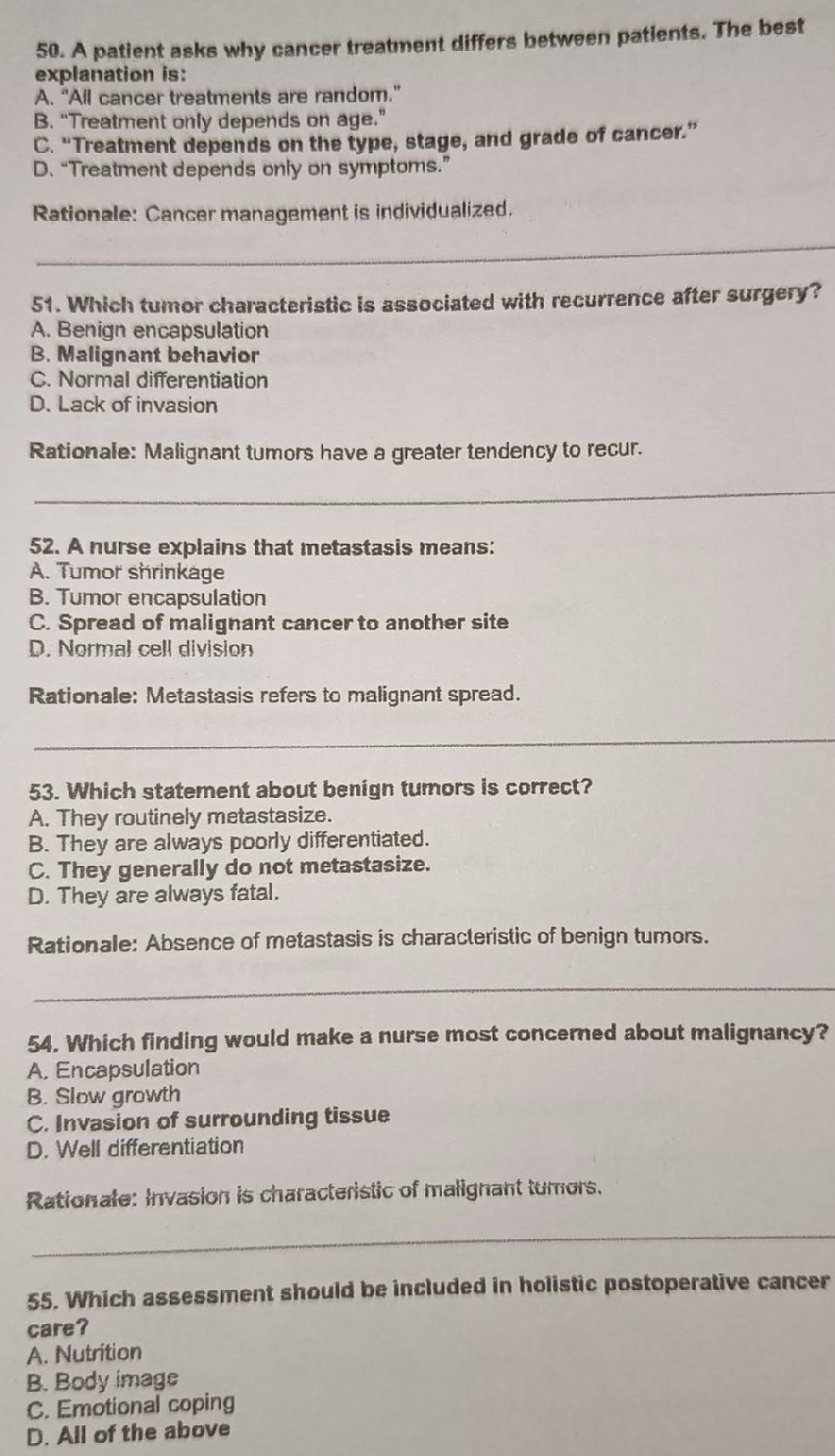
50. A patient asks why cancer treatment differs between patients. The best explanation is:
A. "All cancer treatments are random."
B. "Treatment only depends on age." C. "Treatment depends on the type, stage, and grade of cancer."
D. "Treatment depends only on symptoms." Rationale: Cancer management is individualized.
51. Which tumor characteristic is associated with recurrence after surgery?
A. Benign encapsulation B. Malignant behavior
C. Normal differentiation
D. Lack of invasion Rationale: Malignant tumors have a greater tendency to recur.
52. A nurse explains that metastasis means:
A. Tumor shrinkage
B. Tumor encapsulation C. Spread of malignant cancer to another site
D. Normal cell division Rationale: Metastasis refers to malignant spread.
53. Which statement about benign tumors is correct?
A. They routinely metastasize.
B. They are always poorly differentiated. C. They generally do not metastasize.
D. They are always fatal. Rationale: Absence of metastasis is characteristic of benign tumors.
54. Which finding would make a nurse most concerned about malignancy?
A. Encapsulation
B. Slow growth C. Invasion of surrounding tissue
D. Well differentiation Rationale: Invasion is characteristic of malignant tumors.
55. Which assessment should be included in holistic postoperative cancer care?
A. Nutrition
B. Body image
C. Emotional coping D. All of the above Rationale: Holistic care addresses physical, nutritional, emotional, and body-image concerns.
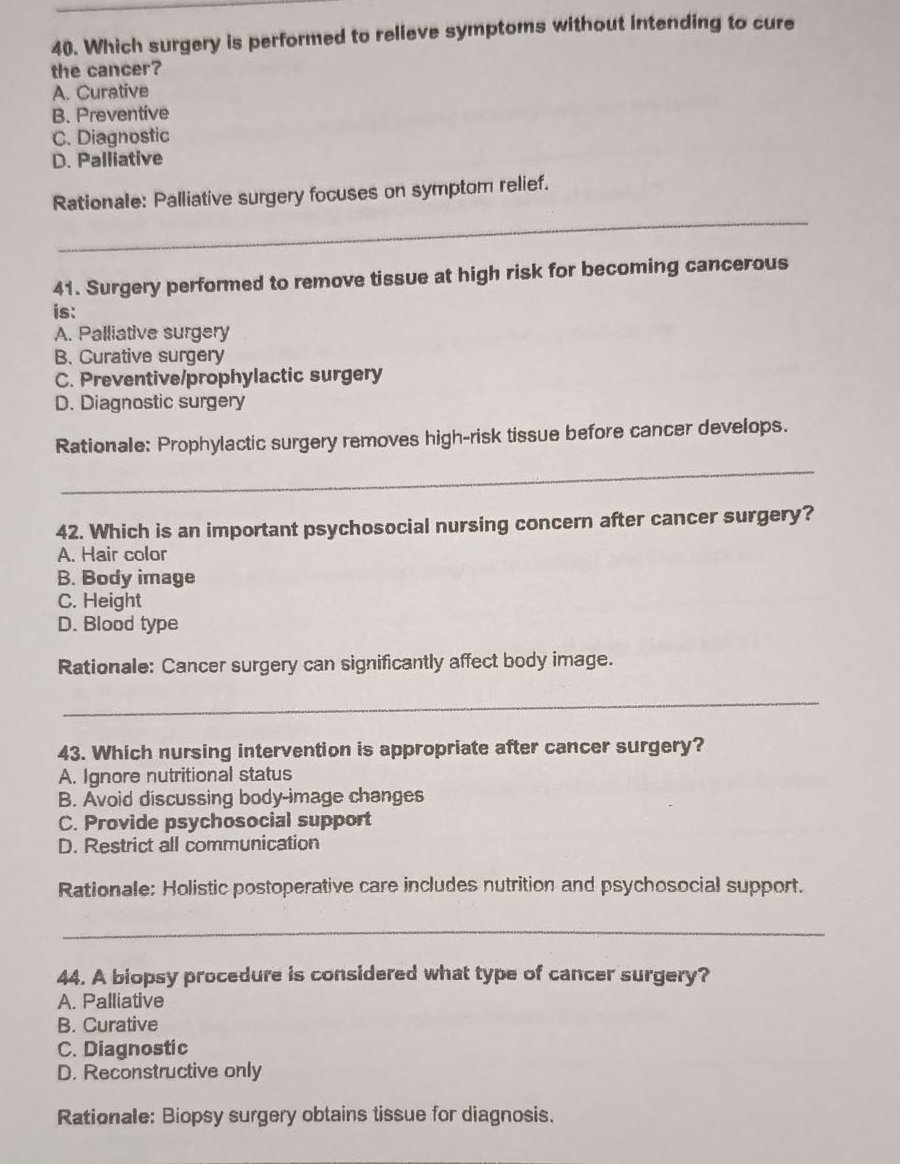
40. Which surgery is performed to relieve symptoms without intending to cure the cancer?
A. Curative
B. Preventive
C. Diagnostic D. Palliative Rationale: Palliative surgery focuses on symptom relief.
41. Surgery performed to remove tissue at high risk for becoming cancerous is:
A. Palliative surgery
B. Curative surgery C. Preventive/prophylactic surgery
D. Diagnostic surgery Rationale: Prophylactic surgery removes high-risk tissue before cancer develops.
42. Which is an important psychosocial nursing concern after cancer surgery?
A. Hair color B. Body image
C. Height
D. Blood type Rationale: Cancer surgery can significantly affect body image.
43. Which nursing intervention is appropriate after cancer surgery?
A. Ignore nutritional status
B. Avoid discussing body-image changes C. Provide psychosocial support
D. Restrict all communication Rationale: Holistic postoperative care includes nutrition and psychosocial support.
44. A biopsy procedure is considered what type of cancer surgery?
A. Palliative
B. Curative C. Diagnostic
D. Reconstructive only Rationale: Biopsy surgery obtains tissue for diagnosis.